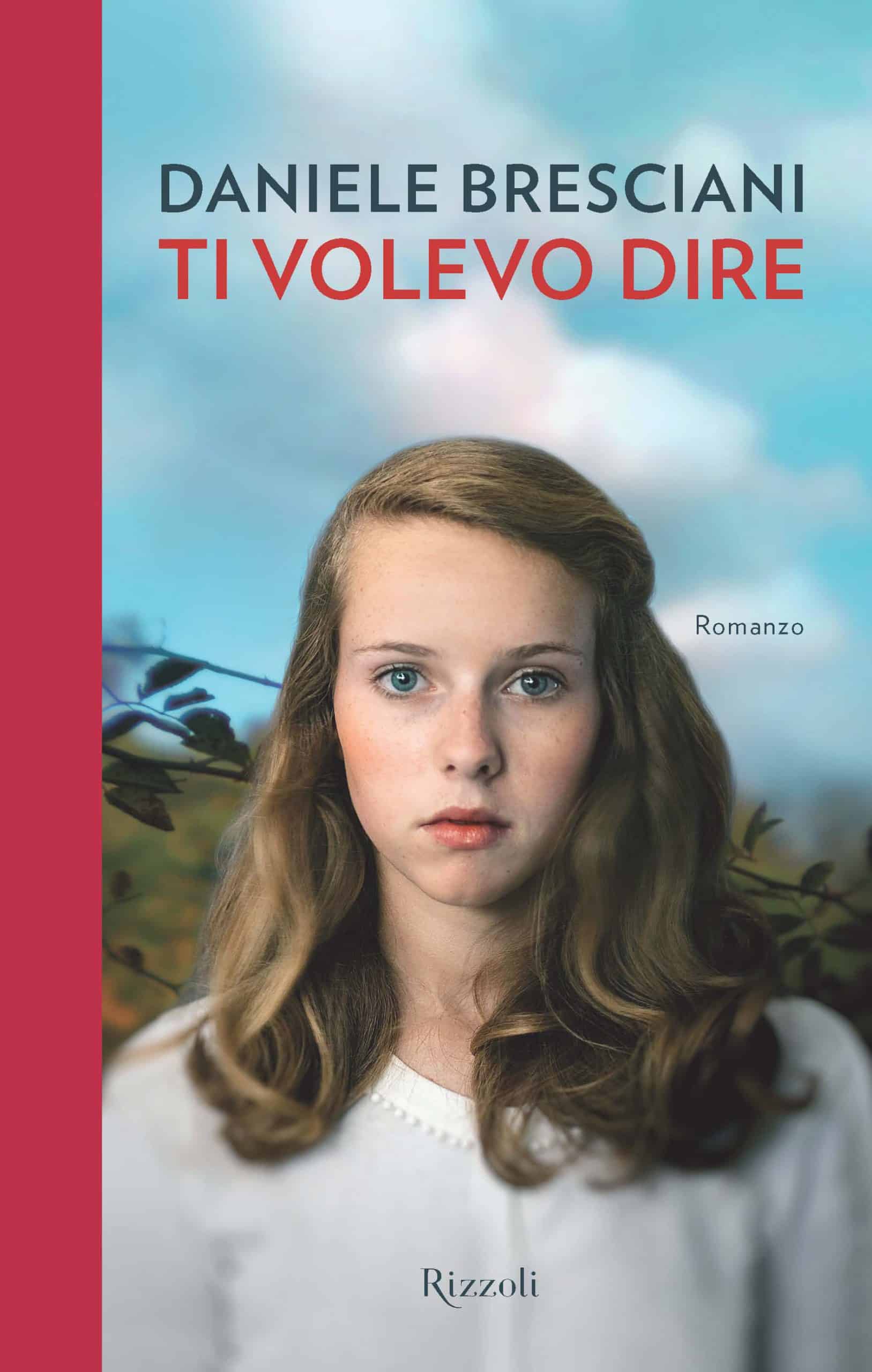
I wanted to tell you
Daniele Bresciani
Ti volevo dire
Rizzoli
Synopsis
Sometimes words get stuck in her throat and won't come out. Viola is just a young girl when one day she gets up and gets dressed, waiting to hear her father's sleepy voice as he drives her to school. But that morning he doesn't wake up, and something inside her stops: selective mutism, the doctors call it, and her mother decides she'll be better off in a Swiss school, where she'll be cared for. Before leaving, Viola receives a precious gift from Fulvio, an old family friend: a bundle of letters, an antique book, and two diaries from her father's past. For an entire winter, in her room at the boarding school, she reads them over and over. The name of a woman she's never heard of before comes up repeatedly: Claire: it was for her that Giacomo moved to London in the early 1980s, dreaming of starting a new life. Viola can't understand why they separated, but she senses that something more is hidden in the end of that relationship: not just a secret kept by Giacomo, but perhaps also the antidote to her own pain. In an intimate and profound novel, Daniele Bresciani tells us how each of us holds onto a handful of words, the ones we can't confess to the people we love, until it's too late. And he tells us that the truth, whether burning or sweet, can take tortuous paths to find us.
Reviews
Elizabeth Barzelloni
G. Vasco Mondovì Scientific High School, class 5^C
Listen to My Silence
"I Wanted to Tell You" is a love story, a slow-burn description of the affection that binds a father and daughter, two friends, a slightly clumsy boy, and a young Englishwoman.
Viola doesn't speak. Her father's death didn't bring a tear to her eyes, but it stole her voice, leaving only a few faded photographs and many letters written on yellowed paper.
At her new boarding school, Viola has no other friends; she has only herself, Leslie, black nails and rock 'n' roll, a careful listener to her silent confidences.
The story told by Daniele Bresciani is so banal and predictable, perfectly consistent with the simple style and colloquial language: a continuous succession of dialogues and letters punctuated by annoying references, too obvious yet implicit, to other literary works.
The ending, terribly predictable, is resolved in a few lines; there is no tragedy; the melodramatic atmosphere that pervades the entire narrative vanishes in a puff of steam on the last page: at the height of the tension, the author abandons his characters to a few ink stains, saying goodbye to them like this, with a hasty summary, without emphasis or pathos.
Elena Bracco
,
“Never having to say: I wanted to tell you”
Words have power, they fill our thoughts, even when they scream out anger or pain, when they disappoint or deceive. They are a succession of sounds with multiple meanings, which for some people are leaves in the wind, for others diamonds. Often our gestures express much more than words, helping us when the latter get stuck in our throats. Yet the words that remain unspoken are always the truest, the most difficult to pronounce, the ones that wear you down, that kill you inside: they rage, they kick in the same way the acts of a play explode from the pages of a book.
This is what Viola, the novel's protagonist, has allowed us to understand and know more deeply. Raised in difficult circumstances, due to the premature death of her father, she must face the trauma of selective mutism. Giacomo, throughout his life, was unable, perhaps out of fear, to bridge the void that exists between a parent and a daughter, allowing time to pass inexorably, right up to the end, thus preventing him from seizing the moment, the essence of the moment, depriving him of emotional connection with his daughter. Sent by her mother to a Swiss boarding school in the hope of resolving her problem, Viola, thanks to a family friend who entrusts her with numerous letters and diaries, is able to learn about her father and the secrets he never confided, which could represent the cure for his pain.
I greatly appreciated the author's idea of simultaneously narrating two parallel stories, which, despite involving different characters and historical periods, are nevertheless closely related.
With a simple and linear style, slower and at times monotonous in the introduction, more flowing and engaging in the second, the author has boldly addressed a topic that is both timely and often overlooked today. The lack of communication between parents and children is, in fact, an increasingly common reality, one that complicates life and from which we must emerge.
"But the truth is that children are never what we would like them to be; we try to mold them in our image when it would be better to let them live. We fill them with things, objects, to fill the voids of spirit and passion. And—speaking for myself, of course—we rarely offer them the truest and most honest part of ourselves."
partner


in collaboration with

with the support of