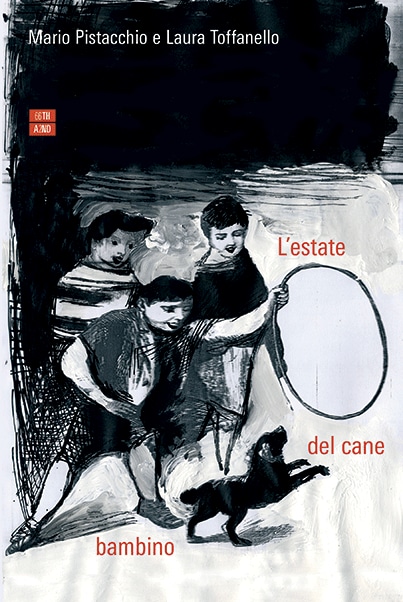
The summer of the baby dog
Mario Pistacchio and Laura Toffanello
L’estate del cane bambino
66thand2nd
Synopsis
Summer, especially when you're young, is the most beautiful season of the year, the one that forever etches indelible memories in your heart. The narrator and protagonist of this novel, Vittorio, is well aware of this, as fifty years later he returns to the place where he spent the summer that ended his youth, making him an adult in an instant and dissolving the innocent bonds of friendship that until then had constituted his very life and were the only thing that truly gave it meaning. We are in Brondolo, a small village near Venice: "Menego was fourteen, Michele, Ercole, and I were twelve, Stalino was almost twelve, and the black dog, who knows. It was the summer of 1961. Our world back then was made of the dead who rose from the dead to kill ungrateful fishermen, of sailing ships carrying the plague, rats and vampires, of fighting clouds and nonexistent knights. It was a time when legends were true, and if someone had told us it was impossible for a child to turn into a dog, we would have shrugged our shoulders and not cared. Five kids spend their days doing what all kids did in those years—football games, trading cards, forays into the fields, sneaking cigarettes, spending hours together in their hidden base or escaping to the nearest town—in the sleepy setting of a provincial town, with its characters as caricatured as they are truthful. The naive
ability—typical of that age—to still believe in legends is the true protagonist of the novel and allows the five friends to delude themselves that Narcissus, the little brother of one of them who disappeared on a hot afternoon of soccer games, has actually transformed into a little black dog, named Houdini. But this episode—so exceptional for children—seems to throw the adults of the peaceful, secretive town into turmoil, and they begin to reveal their darkest and meanest sides: the mysterious atmosphere pervades everyone, and the disastrous arc of that summer culminates with a terrible event that shatters the bonds within the group of friends, marking the end of their innocence and forcing them to grow up forever.
Now, many years later, the protagonist, a Carabinieri captain approaching retirement, has received a letter containing an old drawing: a portrait of a man with a pair of horns throwing a black dog into a well. In an instant, the pull of the past becomes unstoppable, and Vittorio returns to Brondolo to discover, together with his old friends, what happened to Narciso and what really happened that summer, when a child suddenly transformed into a dog, the parents became evil, and all carefree moments ended. And the now adult Vittorio's thoughts often rest on the memory of his grandfather and the beautiful relationship they shared: a message conveyed by the authors, who believe in the possibility of building honest relationships between adults and children, even when things are difficult to express.
The backdrop to the adventures of the group of friends is thus a perfect portrait of village life, the hypocrisy of the inhabitants, their silences, the gossip, but also of the strong bond that develops between children, the small and large adventures they share, and the strength—perhaps only at that age—to fight against something much bigger than themselves.
An often dark and mysterious atmosphere, which at times reminded me of the atmosphere frozen in a sort of suspended time in The Path to the Nest of Spiders .
partner




in collaboration with

with the support of