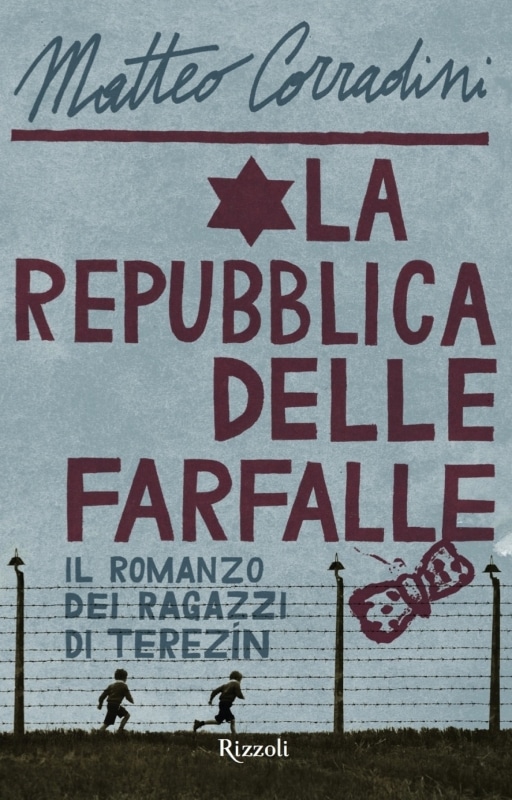
The Republic of Butterflies
Matthew Corradini
La repubblica delle farfalle
Rizzoli
Synopsis
Terezín is located in the Czech Republic. Founded in the late 18th century as a fortress city, during World War II it became a holding camp for Jews destined for extermination. 155,000 people were incarcerated there. Only 3,807 returned home from the Treblinka, Auschwitz-Birkenau, and other concentration camps in the Reich where they had been deported. Approximately 15,000 children and young people lived in the ghetto: by the end of the war, 142 remained alive. Terezín had everything: houses, streets, music, theater. It was a shame there was no freedom. The SS patrolled the ghetto day and night. There was shooting, blood in the streets. Every now and then someone tried to escape and failed; families were separated and tried by all means to stay in touch. Every Friday evening, a group of young people would secretly gather around the glow of a candle to create a newspaper called Vedem, meaning Vanguard. It would compile the latest news: arrivals, departures to their final destination, but also poems, drawings, and interviews. It was their way of fighting, of holding on to the will to stay alive. Many pages of the Vedem newspaper are now preserved at the Terezín Memorial. Matteo Corradini used those documents to recount an extraordinary form of resistance.
Reviews
Stefano Toscano
Vasco Mondovì Linguistic High School, 4th Esa class
“We can even not be afraid of nightmares: the trouble, in Terezín, begins only when you open your eyes.”
Few books are capable of taking the reader by the hand and leading them on a fantastical and emotional journey. Matteo Corradini manages to go further, thrusting us into the fortress city of Terezín, in the Czech Republic, around 1943. He abandons us in the body of a young Jewish man in the ghetto of this Nazi concentration camp and leaves us at the mercy of a raging river of events eager to drown us.
Together with our young friends, we experience many different experiences and follow the life of "Vedem," one of the underground newspapers born from the hope of young people, a flower that blossoms from the earth soaked in the blood of the victims of the Third Reich and at the heart of the story.
Embodying the protagonist and getting under his skin is made easy by the author's style, starting with his creative use of language, reminiscent of a Joycean stream of consciousness, and the character's complete anonymity, a choice that is never explicit and in no way detracts from the writing style, which remains consistently fluid from beginning to end.
The reader travels a long corridor of small, everyday episodes, experiencing different emotions each time, from anger at yet another injustice to the serenity of a blind date that protects the editorial staff, up to the final catharsis.
Recommended without reservation to all lovers of reading with a capital "L" and to anyone who wants to discover an original and different story of hope.
Cloe Curcio
Vasco Mondovì Linguistic High School, 4th ESA class
“Once upon a time, in a faraway kingdom, there was a strange place where all the butterflies were white”…
It all begins with a lightbulb and some children gathered around a table in the dark night. Outside, silence and tranquility reign. It almost seems like a beautiful, happy picture. But there is absolutely nothing joyful about the lives of the Jewish children of Terezín, the fortress city where they are locked up and destined for extermination. These young people, who had the misfortune of being born during World War II, into the then-persecuted community, recount their life in the ghetto through the eyes of an anonymous protagonist. They speak to us of cruelty and violence, of injustice and pain. Alone, without a home or family, they would be crushed by the destructive Nazi system, were it not for their determination not to give in. For this reason, every Friday evening they gather in their hut L417, the children's home, to write about what they see and what they hear. Thus was born "Vedem", Avanguardia, the magazine featuring articles and drawings of life in the ghetto, narrated from the children's point of view. It's a way to resist, to continue living. It's the collection of all the voices of the ghetto, "which may be fragile and weak, but it's a voice against the guards, against the Nazis who continue to speak of us in the past tense, as if we no longer existed."
From March 1943 to November 1944, we follow the experiences of the children of Terezín, narrated with intensity and realism. We experience their imprisonment with them, we watch through their innocent eyes the killings and gratuitous violence of the guards. We are brutally immersed in a world where the word "pity" has no meaning, where the predominant color is gray. But the spark of rebellion, which then culminates in a refusal to give in to despair in the face of Nazi cruelty, connects us with a thread as subtle as it is tenuous to the children and their magazine. It's impossible not to admire their courage, their strength of spirit.
Corradini's style is engaging, his writing in the first person helps us identify with the character. His narrative style is all about immersing the reader in specific emotions or situations, masterfully employing creative writing techniques.
It's a pleasant read, quite fluid. After the first few pages, where it's difficult to orient oneself, the story begins to unfold. Between dreams and reality, experiences and stories, we gradually enter the terrible world of the ghetto. The author paints a vivid picture of what life must have been like in that terrible, yet sadly real, place. Starting with copies of "Vedem," now preserved at the Terezín Memorial, he recounts this extraordinary epic with all his heart. Simple as it may seem at first glance, it reveals great courage and determination on the part of its protagonists. This work leaves a mark on the reader, who, while they may wish to delude themselves into believing the situation could improve, knows they cannot. With dramatic realism, a story is told that is never sugarcoated or simplified. The protagonist is a child who could easily have existed. Perhaps this is precisely what makes "The Republic of Butterflies" a book worth reading. So as never to forget what happened.
Stefano Toscano
Vasco Mondovì Linguistic High School, 4th Esa class
“We can even not be afraid of nightmares: the trouble, in Terezín, begins only when you open your eyes.”
Few books are capable of taking the reader by the hand and leading them on a fantastical and emotional journey. Matteo Corradini manages to go further, thrusting us into the fortress city of Terezín, in the Czech Republic, around 1943. He abandons us in the body of a young Jewish man in the ghetto of this Nazi concentration camp and leaves us at the mercy of a raging river of events eager to drown us.
Together with our young friends, we experience many different experiences and follow the life of "Vedem," one of the underground newspapers born from the hope of young people, a flower that blossoms from the earth soaked in the blood of the victims of the Third Reich and at the heart of the story.
Embodying the protagonist and getting under his skin is made easy by the author's style, starting with his creative use of language, reminiscent of a Joycean stream of consciousness, and the character's complete anonymity, a choice that is never explicit and in no way detracts from the writing style, which remains consistently fluid from beginning to end.
The reader travels a long corridor of small, everyday episodes, experiencing different emotions each time, from anger at yet another injustice to the serenity of a blind date that protects the editorial staff, up to the final catharsis.
Recommended without reservation to all lovers of reading with a capital "L" and to anyone who wants to discover an original and different story of hope.
partner




in collaboration with

with the support of