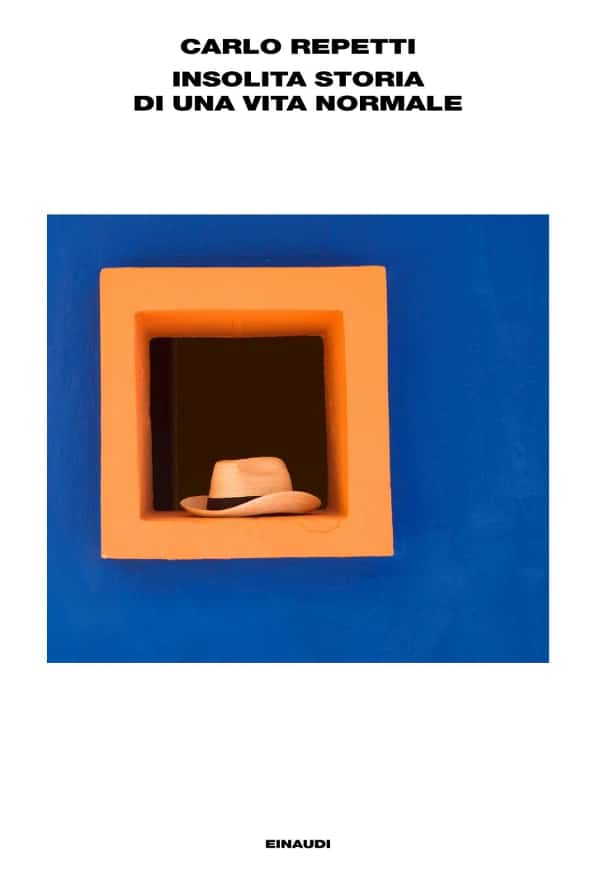
Unusual story of a normal life
Carlo Repetti
Insolita storia di una vita normale
Einaudi
Synopsis
“An eighty-year-old man speaks to his son, a man of forty. They are sitting on a low wall behind a beach, where the city begins. It is late September. The father speaks while gazing toward the horizon, as if he could actually see the things he is describing, in a distant film projected far away. And indeed, those memories come from a very distant land and a distant time.” Thus begins the tale, somewhere between reality and imagination, of the life of a man who has spanned the entire last century, the twentieth century. It is a journey both daily and mythical, ironic and painful, a journey of formation that a father passes on to his son, recounting, along with his own, the thousand other lives that make up the history of mankind. A life narrated “like in a film,” an alternating series of different scenarios: the American home where the protagonist was born, the son of immigrants; the journey with his father to the edge of the Atacama Desert to discover the world; the ship returning from which he sees the Panama Canal and the clouds for the first time; the convent, a place of peace and pain; the alleys of Genoa where he practices medicine "among the living who cannot wait"; the fireworks celebrating the end of the millennium. A life in the "short century" but a long journey across the world, "up and down between hell and heaven.".
Reviews
Marianna Bevacqua
"G. Vasco" Linguistic High School of Mondovì,
“A son who feeds on his father”
Love for a father, for an elderly person, is recognized and acknowledged in adulthood, when that person is at the end of their life, when the light of the spirit is fading, when the body is increasingly weakened and one is ready to leave the earthly world for a perfect, idyllic dimension. This is precisely how one of the two protagonists of "Unusual Story of a Normal Life" feels. Just as his father is about to leave him forever, he longs to spend every moment with him, to hear the stories he couldn't or didn't want to hear in the years before, to nourish himself with that important figure who will soon pass away; he cares for him, stays by his side, and listens to him... even though he would prefer to know everything right away, he allows him to narrate and recount at his own pace, with the necessary pauses; he is patient, he waits, he doesn't ask questions... he simply listens... he makes him feel his presence. This is the story of an eighty-year-old father who, sitting by the sea, gazes at the horizon, recounts his life and experiences to his forty-year-old son as if watching a film of his own life.
It is a sweet tale, full of emotion, sentiment, and details that could belong to a person who lived intensely; set in the twentieth century, a time when belonging to a wealthy family was truly a great fortune. Lorenzo, as the older man is called, had a childhood marked by the loss of a brother, Beniamino, who was always ready to calmly explain to him what was happening in the family and in the world; by a journey around the world with his father, a source of growth and maturation; by a strong faith, already present in him from childhood, strong and alive in everyday life; by a return trip to Italy, his parents' homeland; by a meaningful stay in a convent. primo romanzo , published in 2011, addresses important issues, conveys profound emotions, and helps us understand the social situation of the time. Pleasant to read and definitely recommended for everyone.
Maria Plano
"G. Vasco" Scientific High School of Mondovì,
“Men build diversity as they grow, nurture it with money, and confirm it with power…”
No life is the same as another; in fact, each of us experiences differently, characterized by different emotions, and only death is the only certainty we have in life. We are sure of nothing except that all of us, absolutely all of us, will die one day. And it is this certainty that marks our time.
This novel tells the story of Lorenzo, born into a family of immigrants who left Italy and reached South America in the early 1900s to escape hunger and find gainful employment.
From an early age, Lorenzo and his family have lived through various experiences, some painful due to the death of his brother, and others joyful, such as the journey he took with his father to the edge of the Atacama Desert.
Lorenzo was raised by a wet nurse who, while not his mother, always treated him as if he were her own son. And one day, looking around, he realized that human differences are created as they grow, nurtured with money, and confirmed with power, because he had always gotten along well with other children, even though they weren't of the same race, and felt at ease with them.
As he reached adolescence, he returned to his hometown, but in Italy the enthusiasm he felt for that trip turned to sadness because no place felt like home to him.
So he found refuge in a Franciscan convent, but after a few months, he realized that it wasn't the right choice for him either.
Disillusioned, he was drawn into the Second World War, during which he had to make numerous decisions dictated primarily by the heart, not the mind.
The novel is narrated by Lorenzo himself, now old and weakened, to his son, whose name, however, the author himself does not reveal, leaving the reader somewhat astonished and curious.
The language is fluent and easy to understand. At the beginning of the novel, some Spanish terms are used to further highlight the location of the events. The use of verb tenses is also frequently altered; the events are told from father to son in flashback, while excerpts from Lorenzo's life are told in the present tense.
It's a compelling novel, but it also provokes reflection because it demonstrates that each person is responsible for their own destiny and must make their own decisions, without heeding the opinions of others.
Ilaria Racca
IIS Arimondi-Eula Savigliano,
The book tells the story of a father who recalls episodes from his own life to his son. He begins by explaining that in 1915, his family, like many others, had to emigrate abroad in search of fortune, anticipating the outbreak of the Great War. The old man, as the author himself describes him, first recalls the death of his beloved brother, which took him by surprise when he was still too young to understand what had happened. He also recounts the journey that took him beyond the confines of his home, when he went on business trips with his father, and finally the long voyage by ship that brought him back to his home in Genoa.
During his youth, he felt the desire to enter a convent to test his religious calling, which he felt beating within him, but after only a year he decided to return to his normal life, realizing that even if you are outside the world, you always receive an influence from the outside.
During the years of Fascism and the Resistance, he became a skilled and well-regarded doctor. The old man's story ends, and he closes his eyes forever. Upon his father's death, the son finds himself alone in the house where his father died, which is now empty yet filled with memories and experiences he tries to capitalize on.
The book is very interesting and thought-provoking, although at times it becomes almost flat, leaving no suspense, leaving the reader with an immediate understanding of how events will unfold. Nevertheless, it is a very smooth and enjoyable read.
partner

in collaboration with

with the support of