Cate, I
Matteo Cellini
Cate, io
Fazi
Synopsis
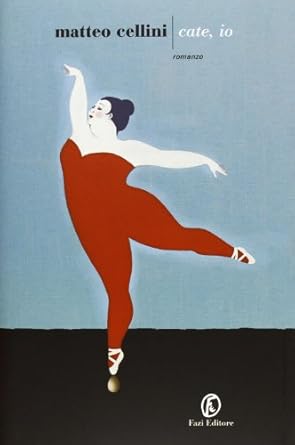
There are wars that have no respite, heroes without fanfare. Caterina is one of them: a seventeen-year-old veteran who begins the fight every morning, entering the torture of clothing. Because Caterina is obese, and the only normality she knows is within the walls of her home, in an obese family. Her identity disappears upon contact with the rest of the world, because outside, the only way to survive is to become Cate, the fiercely self-deprecating superheroine whose power is to "be the comparison that saves": no one is uglier, fatter, or lonelier than her. Caterina walks head-on through the hostile world: she crosses the forests of nicknames, dresses herself in the desire to be invisible, rejects the pity of others. Her place in the world is burdened by disproportion, but her lifeboat is her intelligence, her weapon the sarcasm with which she anticipates the judgment of others, anesthetizing it before it hits hard.
Reviews
Enrica Abbona
Vasco Mondovì Linguistic High School, 4th Esabac
“They used more play dough to make me than they did to make you. But we're the same.”…
… This is what Cate thinks, the protagonist of Matteo Cellini's primo romanzo , published by Fabri Editore. Born in Urbino and a middle school literature teacher, Cate is 17 years old and lives with a huge psychological problem, conditioned by her physical appearance. Her entire family is overweight, but unlike Cate, what she sees as a "problem" doesn't affect her siblings' lives. Her favorite refuge is her home, where she can be herself without fear, but every time she leaves the house she transforms into a nameless being who isolates herself from the world, who sees what she wants to see, who imagines or puts despicable words or false judgments into the mouths of those around her. Because of this exaggerated imagination, Cate becomes increasingly withdrawn, trying to be impeccable in her studies so that she has only one weakness: her physique. Thus, she begins to reject all attempts at friendship and postpone her eighteenth birthday because she fears she won't be able to handle all the stares and whispered judgments from the guests. She goes to great lengths to cancel the event; her own fears make her do things she never thought possible. Only when she reaches rock bottom will she realize that the only thing that can save her is friendship. Cate thinks often and reflects, but her thoughts often become so convoluted that, in the end, she loses the thread of the story. Furthermore, the lack of dialogue in some parts makes the narrative slow and cumbersome. Personally, I found the story uninteresting, even though the subject matter is very sensitive and timely. The ending is also rather predictable.
Lorenza Chiera
G. Vasco Mondovi Scientific High School, 5C
"I'm like a minus in front of all my ideas"
It's in a closed world that revolves around food that Caterina, known as Cate, the novel's heroine, grows up with a thousand questions and worries. Everything seems different once she leaves the house: the eyes of those watching her pass by betray mockery, their mouths twisted in grimaces of contempt, the knowing glances exchanged by the boys, and the words spoken and unsaid in hushed tones... Thus Cate becomes Cate-Ciccia, withdrawing into herself until she returns home. At school, she sits in a desk at the back of the room that is never noticed; only Anna the Annoying and then Giacomo try to strike up a conversation, asking her advice, information, and gossip. Only thanks to Professor Mazzantini and the relentless Anna does Cate decide to open her eyes and free her mind from prejudice and nastiness. After a desperate attempt to end a life she considers ignoble and pointless, Cate discovers the tricks to improving her life and her relationship from her brother Gionata, who inspires her to embark on her rebirth. She gives it her all and realizes she mustn't let friends like Anna and Giacomo slip away, because they could be the guiding lights on her difficult journey. Indeed, they are the ones who help her believe in herself in times of need, and it is with them that she wants to spend her adolescence.
With direct and clear language, the author transports the reader directly into Caterina's mind, allowing us to grasp her every thought and feel as if we're growing up alongside her. Every sentence, every thought is shared with the reader, who becomes so connected to Cate that they begin to think the same way, to be influenced by her.
Cate, on the cusp of turning eighteen, rediscovers meaning in her life and finally manages to erase all traces of her theories about non-persons—namely, obese people—and begin to truly live. The book is a smooth and enjoyable read, becoming a refuge in which to hide, just as it does for Cate-Ciccia.
partner




in collaboration with

with the support of