At the end of everything
Mauro Garofalo
Alla fine di ogni cosa
Frassinelli
Synopsis
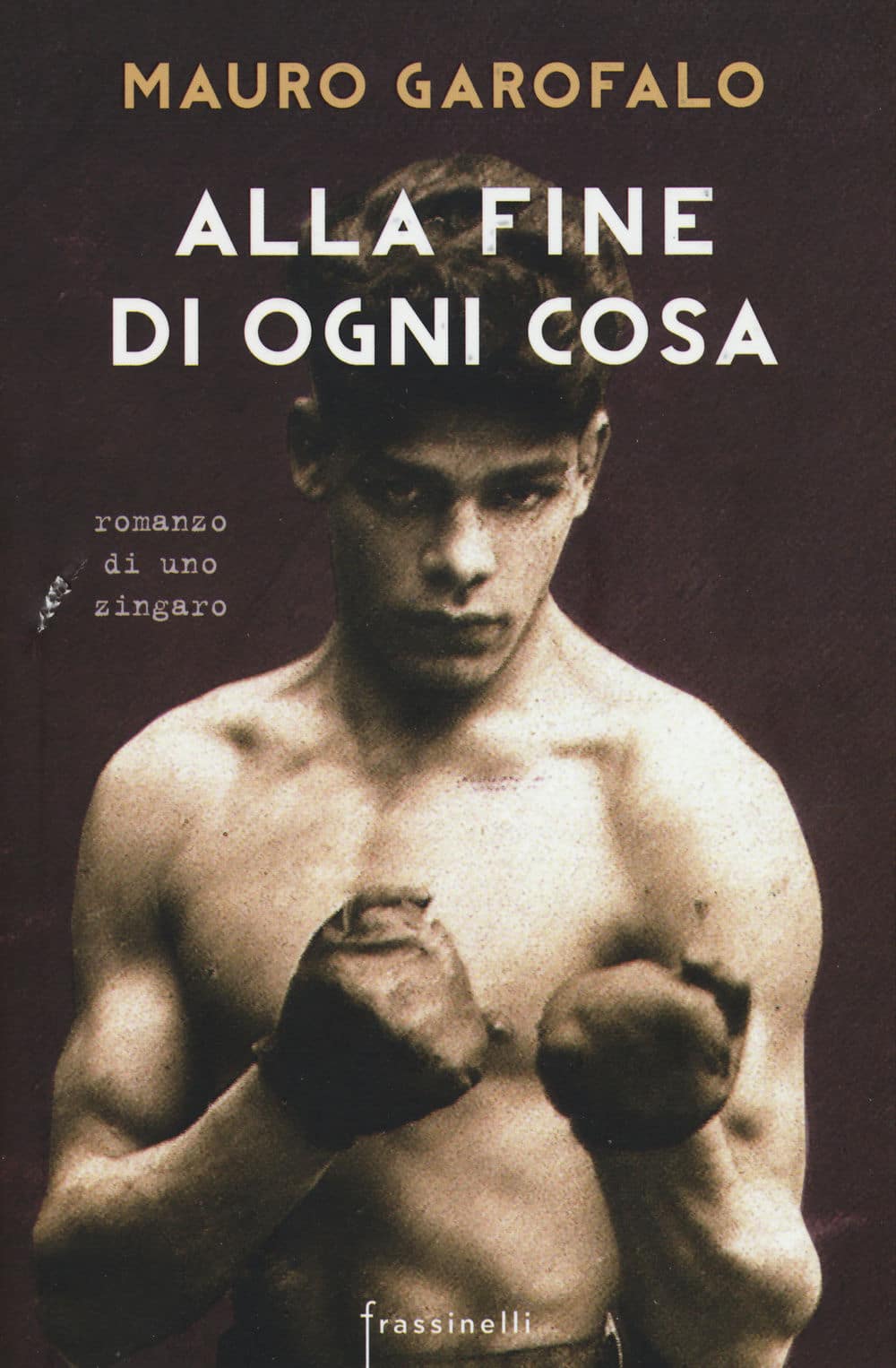
Every day lived as if it were the last. Every match, every word spoken, the last chance. “The first time I heard the name Johann Rukeli Trollmann I had just finished punching bag training. With my hands still bandaged and gloves on, I learned the story of the boxer whose champion title had been stripped by the Nazis because he was a “gypsy.” In response, the next time Trollmann had climbed into the ring with his body covered in flour, his hair dyed yellow, he had let himself be beaten. That man had staged the defeat of the same Aryan fanaticism that was now crucifying him; he had had the courage to look straight in the face the great evil of the twentieth century. I realized that this was not just any story, it was a challenge. And I had to follow it.” Mauro Garofalo tells the story of the German boxing champion of the 1930s Johann Trollman, known as Rukeli, as only great novelists know how: he merges with his character, takes on his gaze and emotions and takes us with him to the most terrible moment in history, making us experience a human and sporting story, tragic and beautiful.
Reviews
Davide Camoirano
Vasco Beccaria High School, Govone, Mondovì, 3rd A scientific class
A destiny that inevitably comes true
Mauro Garofalo's novel tells the story of a German boxer of Gypsy origin, Johann Trollmann, nicknamed "Rukeli" for his uncanny resemblance to a tree. While fighting a match in his hometown of Hanover, he is spotted by a Berlin trainer, Zirzow, who is immediately struck and fascinated by the young man's distinctive boxing style, something he has never seen in any other fighter. Sensing his potential, he offers him the chance to train at his gym in the capital. Johann accepts, not without some hesitation, and from that moment on, the path to the light-heavyweight title becomes clear, with the Gypsy racking up one victory after another. His fate seems sealed when, at the height of his physical and mental fitness, an ambitious and enterprising young man of Austrian origin, Adolf Hitler, emerges onto the German political scene and quickly imposes his ideology, based on the purity of the Aryan race, on the Teutonic people. Meanwhile, Johann has reached the final of his category, just one step away from the title he'd coveted since childhood. He wins it in the ring, but the Nazis revoke his victory for conduct contrary to the Faustkamp, the fighting ideal imposed by Hitler and his followers, and he is forced to fight another match. It's the beginning of the end for Johann.
This novel seems to follow the same lines as many others published in recent years on the theme of Nazism/racism, but it provides another perspective from which to observe and analyze the scenario unfolding with the arrival of the Führer: that of a promising athlete whose career is thwarted by the twisted, nationalistic minds who rose to power in those years. The author intertwines the private life of the boxing champion, revered by women and deeply connected to his past and the village where he was born and raised in Hanover, with his sporting life, providing technical and realistic descriptions of the blows he delivered and his psychological state during his matches and training.
Garofalo employs numerous rhetorical devices, such as metaphors and analogies, to sculpt his characters, particularly the protagonist, in their various facets. These are accompanied by colorful and allusive language, creating a literary atmosphere that is both pleasant and prompts reflection on something seemingly past, yet so present and vivid today as never before. The author's skillful use of sentences of varying lengths, depending on the situation and the importance he wanted to instill in that image, demonstrates his attention to the reader's psychological component. These devices enable him to focus attention on the events, characterized by short, direct sentences, and on the descriptions of characters and settings, marked by rhetorical devices and long, detailed sentences.
I recommend this novel both to the occasional reader, who could easily grasp the plot and message, and to the more assiduous reader, capable of grasping the socio-political intricacies and the more subtle details.
Alessia, Andrea O., Andrea P
IIS Arimondi-Eula Savigliano, class IV D accountants
"At the End of Everything" by Mauro Garofalo is a novel inspired by the true story, set in Nazi Germany, of a Gypsy boxer named Johann Trollmann, known as Rukeli (tree).
Hitler's rise to power paralleled his rise through the ranks of the elite boxing world. But as soon as Hitler became chancellor, the young man began to encounter endless problems, both in his career and in his daily life: intolerance and the persecution of "different" people became the norm in the country that presented itself to the world as the Third Reich.
When Trollmann finally had the chance to win the championship, the Sports Federation stripped him of the title, precisely because he was a Gypsy, erasing the results of a clean victory in the ring.
The young man fought at the front during the Second World War and, upon his return, was arrested and deported to a concentration camp, where he would end his life in a way that has never been fully explained.
The book, which reconstructs the life story of the young Roma, is rich in references to historical events that shaped the history of the twentieth century, and not only in Germany. Rukeli's deeply compelling personal story offers the author an opportunity to reflect on the persecutions carried out with purely racial motivations, based on pseudo-scientific theories regarding the supposed inferiority of certain races, including the "Gypsy race." It sparks interest in an often-forgotten persecution—that of the Gypsies.
It also vividly describes how the Gypsy champion's victory tarnishes, in the eyes of the Reich authorities, the noble art of sport, in which only athletes possessing physical characteristics easily identifiable as Aryan purity have the right to stand out and triumph, to stand on the podium of victory. Although Rukeli is healthy, well-built, and a skilled fighter, he is unworthy of a title to which only the perfect members of the Hitler Youth can aspire.
When we read the book, we had just seen the film "Race," which chronicles the story of Owens, a four-time gold medalist at the 1936 Olympics, and it was natural for us to draw a parallel between the two athletes: a Black man and a Gypsy, both of whom, as a result of racial laws, had become "subhuman."
We believe the book can inspire young people to reflect on timely issues, and we believe the author is right when he said, in a recent interview, that "he has recounted, weighing every syllable, seeking precision, a fall, a shattered dream, a young man unable to fill the void that surrounded him."
partner




in collaboration with

with the support of