News and events
10.12.2011
Interview with Andrea Molesini
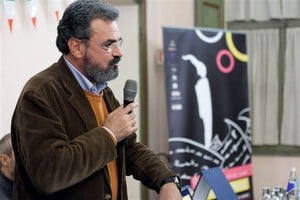
Andrea Molesini won the Cuneo City Prize for Primo Romanzo. The author will be speaking in Cuneo at the 13th edition of Scrittorincittà. with his book Not All Bastards Are from Vienna (Sellerio 2010)
You've translated American authors. The book at times reminded me of Hemingway's descriptions. How much Hemingway is there in your novel?
Little or nothing, I'd say. If there are any similarities, they're entirely coincidental. I read A Farewell to Arms as a boy, more than thirty years ago. If anything, what really struck me was the technique of dry dialogue inserted into a narrative flow of high emotional content: that's Hemingway, of course. But there are other models I feel closer to: Simenon's A Snow Was Dirty, for one.
As I read the book, a feeling often came over me: fear of the enemy, as if I were hunted, as if a sniper were lurking behind every page. Reflecting on this feeling, and on the fact that I experience this feeling even in moments of our time of peace, I asked myself, and I ask you: who is the enemy today? Who is the sniper lurking on the corners of our streets today, or in the corners of our minds?
Perhaps our awareness (never declared, I believe, for reasons of superstition) that we were at the end of an era of privilege. In the late spring of 1914, almost no one foresaw that Europe's suicide, the immense carnage that would overwhelm all colonial empires, even those victorious from the conflict, was looming. The eternal enemy of free and civilized coexistence is stupidity—which, unlike intelligence, is a force that knows no limits or boundaries. And stupidity lies in the selfishness of each and every one. A historical-existential novel is also an act of divination, a divination directed toward the past, toward those things of the past that remain unknown.
Young Paolo is formed during the war and thanks to it: in the second part of the book, he has reached a mature conscience and is able to personally commit himself to defeating the enemy. Like the partisans of the Cuneo valleys after September 8th. What shapes young people today? There seems to be no incentive, like war, so violent as to induce rebellion. Everything is more subtle, and everything accustoms young people to resignation and indifference. What do you think?
I agree. But we must be careful: wishing for a war to redeem the world from apathy is foolish. War is death and destruction, an unstoppable river of pain, and it's not true that a better world emerges from a war: it happened in 1945, but only in part of Europe, and only because the new colonizers, the United States of America, were generous by nature and exported liberal institutions, being more interested in flourishing trade than in political and military domination. But I believe this is an exception. After wars, there is only misery and injustice, and they last a long time. In its long history, humanity remembers very few Marshall Plans. However, one thing remains true: Zeus gave the Greeks endless grief beneath the walls of Troy so that they would have material for song, so they would have something to tell by the fireside. We have always told stories about war, even the love stories we pass on are those of Romeo and Juliet and Anna Karenina.
The relationship with God: the novel reveals anger toward the Almighty, seeing him as indifferent and useless in the face of human tragedy. This attitude takes me back to the Second World War, to the Jews and the "God who is dead," but also to Edith Stein or Simone Weil, who went through hell without ever losing their faith, or to theologians like Bonhoeffer, who, awaiting execution, never turned to the Father in doubt or disbelief. Reading the book, I couldn't help but wonder about your relationship with faith.
I disagree. In Not All Bastards Are from Vienna, there is never any anger toward the Almighty. It's an attitude that isn't mine and that no character born from my imagination could embody. In my novel, there are different positions on faith: there's the priest-hating grandfather and the secret agent (probably a Freemason), there's the aunt who believes more in the Church than in God and there's a parish priest animated by a peasant faith, down-to-earth but not resigned; there's even a certain indifference in the mathematical grandmother, who satisfies her hunger for eternity and beauty in the miracle of the dance of numbers; there's the cook who in her refrain associates the devil with holy water (diambarne de l'ostia), thus embodying a form of faith that is primitive but not without human value; and there's the narrative voice, that of a boy who faces the world with the attitude of a robber, never with that of a beggar; It's not clear whether he believes or not. He observes faith in others, regards it with skepticism, enchanted as he is by his grandfather's seemingly cynical gaze and that of Renato... This is what human comedy is all about. I remember that Martin Buber wrote somewhere that no one can say whether God exists or not. It's a poorly posed question: some men, few or many, I don't know, love some image of God, have some idea of him, this love is an action, and the world is everything that happens.
With its highly evocative descriptions and its atmospheres that seem like authentic screenplays, the book lends itself well to being made into a film. Would you like to see it? Who would direct and star?
I'd love to, of course. But the idea also scares me a little, because when a book becomes a film, the book is rarely read the same way. There are many talented directors; I particularly love Giorgio Diritti, The Wind Blows Round , and The Man Who Will Come.
You won the Campiello, the Comisso, and the City of Cuneo Awards. They're not the same thing, but, honestly, what does it mean to you to be coming to Cuneo to collect the award?
A great pleasure, and a sense of gratitude.
interview by Laura Conforti
partner


in collaboration with
with the support of